Last 10 Ayat of Surah Al Imran Translation and Benefits

Surah Al Imran, originally known as Surah Al-e-Imran, is the third chapter of the Quran, comprising 200 ayahs (verses). In this article, we will discuss the last 10 Ayat of Surah Al Imran. We will explore the Arabic text, English and Urdu translations, relevant Ahadith, and narrations that highlight the benefits and rewards of reciting these verses.

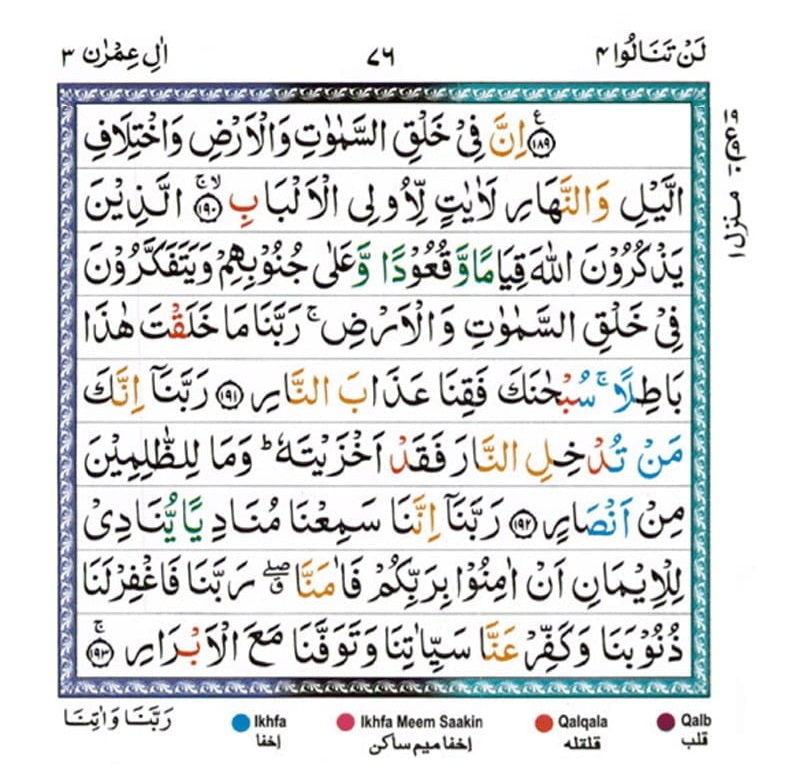
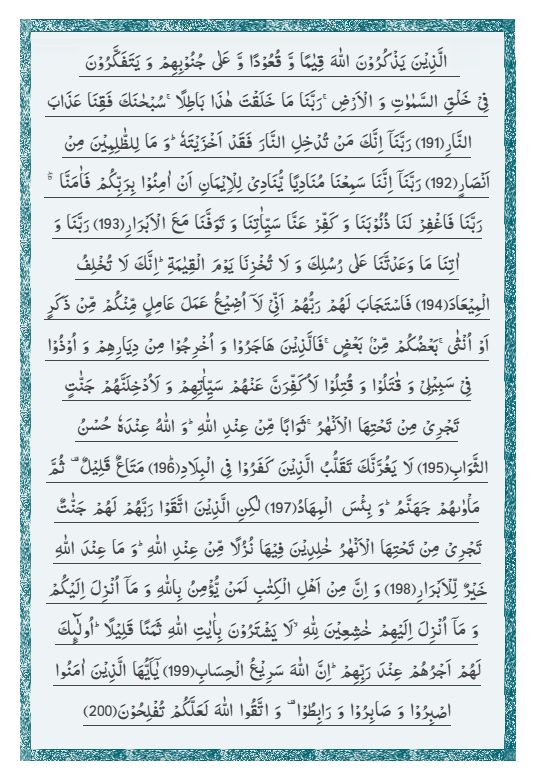
Last 10 Ayat of Surah Al Imran Arabic

 الَّذِیْنَ  یَذْكُرُوْنَ  اللّٰهَ  قِیٰمًا  وَّ  قُعُوْدًا  وَّ  عَلٰى  جُنُوْبِهِمْ  وَ  یَتَفَكَّرُوْنَ  فِیْ  خَلْقِ  السَّمٰوٰتِ  وَ  الْاَرْضِۚ-رَبَّنَا  مَا  خَلَقْتَ  هٰذَا  بَاطِلًاۚ سُبْحٰنَكَ  فَقِنَا  عَذَابَ  النَّارِ

رَبَّنَاۤ  اِنَّكَ  مَنْ  تُدْخِلِ  النَّارَ  فَقَدْ  اَخْزَیْتَهٗؕ-وَ  مَا  لِلظّٰلِمِیْنَ  مِنْ  اَنْصَارٍ

رَبَّنَاۤ  اِنَّنَا  سَمِعْنَا  مُنَادِیًا  یُّنَادِیْ  لِلْاِیْمَانِ  اَنْ  اٰمِنُوْا  بِرَبِّكُمْ  فَاٰمَنَّا  ﳓ  رَبَّنَا  فَاغْفِرْ  لَنَا  ذُنُوْبَنَا  وَ  كَفِّرْ  عَنَّا  سَیِّاٰتِنَا  وَ  تَوَفَّنَا  مَعَ  الْاَبْرَارِ

رَبَّنَا  وَ  اٰتِنَا  مَا  وَعَدْتَّنَا  عَلٰى  رُسُلِكَ  وَ  لَا  تُخْزِنَا  یَوْمَ  الْقِیٰمَةِؕ-اِنَّكَ  لَا  تُخْلِفُ  الْمِیْعَادَ

 فَاسْتَجَابَ  لَهُمْ  رَبُّهُمْ  اَنِّیْ لَاۤ اُضِیْعُ  عَمَلَ  عَامِلٍ  مِّنْكُمْ  مِّنْ  ذَكَرٍ  اَوْ  اُنْثٰىۚ-بَعْضُكُمْ  مِّنْۢ  بَعْضٍۚ-فَالَّذِیْنَ  هَاجَرُوْا  وَ  اُخْرِجُوْا  مِنْ  دِیَارِهِمْ وَ اُوْذُوْا فِیْ سَبِیْلِیْ وَ قٰتَلُوْا وَ  قُتِلُوْا  لَاُكَفِّرَنَّ  عَنْهُمْ  سَیِّاٰتِهِمْ  وَ  لَاُدْخِلَنَّهُمْ  جَنّٰتٍ  تَجْرِیْ  مِنْ  تَحْتِهَا  الْاَنْهٰرُۚ-ثَوَابًا  مِّنْ  عِنْدِ  اللّٰهِؕ-وَ  اللّٰهُ  عِنْدَهٗ  حُسْنُ  الثَّوَابِ

لَا يَغُرَّنَّكَ تَقَلُّبُ الَّذِينَ كَفَرُوا فِي الْبِلَادِ

مَتَاعٌ قَلِيلٌ ثُمَّ مَأْوَاهُمْ جَهَنَّمُ وَبِئْسَ الْمِهَادُ

لٰكِنِ  الَّذِیْنَ  اتَّقَوْا  رَبَّهُمْ  لَهُمْ  جَنّٰتٌ  تَجْرِیْ  مِنْ  تَحْتِهَا  الْاَنْهٰرُ  خٰلِدِیْنَ  فِیْهَا  نُزُلًا  مِّنْ  عِنْدِ  اللّٰهِؕ-وَ  مَا  عِنْدَ  اللّٰهِ  خَیْرٌ  لِّلْاَبْرَارِ

وَ  اِنَّ  مِنْ  اَهْلِ  الْكِتٰبِ  لَمَنْ  یُّؤْمِنُ  بِاللّٰهِ  وَ  مَاۤ  اُنْزِلَ  اِلَیْكُمْ  وَ  مَاۤ  اُنْزِلَ  اِلَیْهِمْ  خٰشِعِیْنَ  لِلّٰهِۙ-لَا  یَشْتَرُوْنَ  بِاٰیٰتِ  اللّٰهِ  ثَمَنًا  قَلِیْلًاؕ-اُولٰٓىٕكَ  لَهُمْ  اَجْرُهُمْ  عِنْدَ  رَبِّهِمْؕ-اِنَّ  اللّٰهَ  سَرِیْعُ  الْحِسَابِ

 یٰۤاَیُّهَا  الَّذِیْنَ اٰمَنُوا اصْبِرُوْا وَ صَابِرُوْا وَ رَابِطُوْا وَاتَّقُوا  اللّٰهَ  لَعَلَّكُمْ  تُفْلِحُوْنَ

Surah Al Imran Last 10 Ayat

Translation of the Last Ten Ayats of Surah Al Imran

Those who remember Allah standing, sitting, and on their sides (lying down) and reflect upon the creation of the heavens and the earth. “O our Lord! You did not create ˹all of˺ this without purpose. You are Pure, so save us from the punishment of the Fire.

O our Lord! Indeed, whomsoever You will send to Hell, You have surely humiliated him, and for the oppressors, there is no helper.

O our Lord! Indeed, we heard a caller expressing a call of faith, ‘Believe in your Lord”, so we believed. O, our Lord! Forgive our sins and erase our evil deeds, and grant us death with the righteous.

O our Lord! Grant us that which You promised us through Your Messengers and do not disgrace us on the Day of Judgement. Indeed, you do not break your promise.”

So their Lord answered their prayer, “I shall not waste the endeavour of those who comply among you, male or female; you are one among each other. So those who migrated and were driven out of their homes, and were persecuted in My way, and they performed Jihad, and were killed, then I shall most certainly forgive their sins, and I shall most definitely make them enter gardens beneath which rivers are flowing; ˹this is˺ reward from the Court of Allah. And with Allah alone, there is an excellent reward.

O listener! The carefree wandering of the disbelievers within cities should certainly not deceive you.

Limited provisions. Then their abode will be Hell, and what a terrible abode it is.

However, those who fear their Lord, for them there are gardens beneath which rivers flow, they will reside therein forever; ˹this is˺ a provision of hospitality from Allah, and that which is with Allah is best for the virtuous.

And indeed some People of the Book believe in Allah and that which was revealed to you, and that which was revealed to them, being deeply submissive before Allah; they do not exchange the verses of Allah for a trivial sum. These are the people whose reward is with their Lord, and Allah is Most-Swift in Reckoning.

O you who believe! Be patient[1] and exceed your enemies in tolerance and guard the Islamic boundary; and fear Allah that you may attain success.

Benefits of Reading the Last 10 Ayat of Surah Al Imran

Kuraib reported that Ibn Abbas narrated to him that he spent a night in the house of Maimuna (may Allah be pleased with her), the mother of the believers, who was his mother’s sister. He lay down across the cushion, while the Messenger of Allah (ﷺ) and his wife lay down lengthwise.

The Messenger of Allah (ﷺ) slept until midnight, or a little before, or a little after, and then got up, rubbing the effects of sleep from his face with his hand. He then recited the ten concluding verses of Surah Al Imran, performed ablution near a hanging water-skin, and stood up to pray. (Reference: Sahih Muslim 763b)

This hadith highlights the habit (Sunnah) of the Messenger of Allah (ﷺ) of reciting the last 10 ayat of Surah Al Imran upon waking. Therefore, adopting the practice of reciting these verses when waking up is beneficial, as it aligns with the Sunnah of the Prophet (ﷺ).

Let’s consider another authentic hadith that illustrates the benefits of reading Surah Al Imran.

Al-Nawwas Ibn Sam’an reported that the Messenger of Allah (ﷺ) said:

The Qur’an will be brought on the Day of Judgment, along with its companions who used to act by it, with Surah Al Baqarah and Surah Al Imran at the forefront.

The Messenger (ﷺ) likened them to three things that I did not forget: they will be like two clouds, or two black canopies with light between them, or like two flocks of birds in ranks pleading for the one who recited them.” (Reference: Sahih Muslim 805)

Ayatul Kursi – Powerful Ayat of Quran – Benefits and Importance

Ayatul Kursi is one of the most famous verses in the Quran. It is verse 255 from Surah Al-Baqarah. This verse talks about the greatness of Allah (God) and His power over everything. In this article, we will explore what Ayat ul Kursi means, its importance, and how we can use it in our daily lives.

What Does Ayatul Kursi Say?

Ayat ul Kursi describes Allah as the One who is always awake and never sleeps. It tells us that He knows everything, from what happens in the sky to what happens on the earth.

This verse reminds us that Allah is the Creator of the universe and is in control of everything. It also mentions that no one can help us except Allah. This is a powerful reminder of our reliance on Him.

Why Is Ayat ul Kursi Important?

There are many reasons why Ayat ul Kursi is important for Muslims.

  • It teaches us about the greatness of Allah. Knowing that Allah is all-powerful and all-knowing gives us comfort and strength in our lives. When we face difficulties, we can remember that Allah is always there to help us.
  • Ayat ul Kursi is known for its protection. Many Muslims recite this verse every day, especially after their prayers. Reciting Ayat ul Kursi protects us from evil and harm. This verse can create a sense of safety and peace in our hearts.

How to Recite Ayat ul Kursi

Reciting Ayatul Kursi is easy and can be done by anyone. You can say it in Arabic, or you can read its translation in your language to understand its meaning better. It is recommended to recite this verse after the five daily prayers and before going to sleep. You can also say it whenever you feel scared or worried.

The Benefits of Ayat ul Kursi

There are many benefits to reciting Ayat ul Kursi regularly.

First, it brings blessings into our lives. When we remember Allah and acknowledge His greatness, we invite His mercy and blessings. This can lead to a happier and more peaceful life.

Moreover, Ayatul Kursi helps strengthen our faith. When we recite it, we remind ourselves of Allah’s power and protection. This can help us feel more secure and confident in our daily lives.

Ayat ul Kursi is a powerful verse that teaches us about the greatness of Allah. It reminds us that He is always there to protect and help us. By reciting this verse, we can find comfort, strength, and blessings in our lives.

So, let’s make it a habit to recite Ayat ul Kursi daily and share its importance with others. Through this simple act, we can deepen our connection with Allah and live a life filled with faith and peace.

Islamic Wazifa for a Blessed Marriage: Steps and Benefits

A wazifa for shadi (marriage) is a supplication or set of prayers used in Islam to seek Allah’s help in finding a suitable spouse or for the smooth progression of a marriage. Here is a simple yet powerful wazifa that you can perform for marriage:

Wazifa for Marriage

  1. Surah Al-Fatiha (The Opening): Recite it 7 times.
  2. Durood Sharif: Recite any form of Durood (like Durood-e-Ibrahimi) 11 times.
  3. Ayat-ul-Kursi (2:255): Recite Ayat-ul-Kursi 3 times.
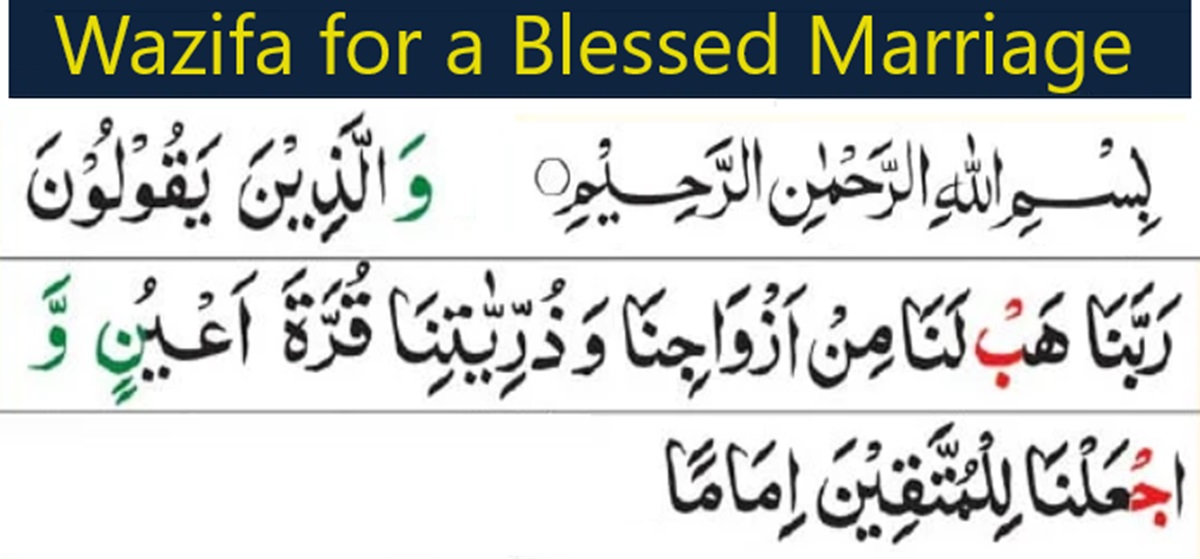
  4. Surah Al-Furqan, Verse 74 (25:74): Recite the following verse 41 times after any obligatory prayer (Salah):

رَبَّنَا هَبْ لَنَا مِنْ أَزْوَاجِنَا وَذُرِّيَّاتِنَا قُرَّةَ أَعْيُنٍ وَاجْعَلْنَا لِلْمُتَّقِينَ إِمَامًا

Transliteration:
“Rabbana hab lana min azwajina wa dhurriyyatina qurrata a’yunin waj’alna lil-muttaqina imama.”

Translation:
“Our Lord, grant us from among our wives and offspring comfort to our eyes and make us an example for the righteous.”

End with Durood Sharif: Recite it again 11 times.

Important Guidelines of Wazifa:

  • Intent (Niyyah): Have a sincere intention in your heart that you are asking Allah for help in marriage.
  • Timings: It’s good to perform this wazifa after any of the five daily prayers, but it’s especially beneficial after Fajr or Isha.
  • Consistency: Continue doing this wazifa regularly for at least 21 or 41 days, or until you receive results.
  • Patience and Trust: Trust Allah’s timing, as He knows what’s best.

May Allah (SWT) make your journey easy and grant you a righteous spouse!

The Power and Significance of Dua in Islam

In Islam, Dua (دعاء) holds a unique and profound place as a direct form of communication between the believer and Allah (God). It is not just a practice, but a vital connection that bridges the human with the Divine.

Unlike the formalized prayers (Salah), Dua is a personal supplication where one can express their innermost thoughts, desires, and needs. This beautiful act reflects humility, devotion, and a recognition that Allah is the ultimate source of all guidance and blessings.

This article delves into the significance, etiquette, and benefits of dua, offering a glimpse into its spiritual importance in a Muslim’s life.

The Meaning and Purpose of Dua

The term Dua in Arabic means “call” or “invocation.” It is essentially a plea or request from the servant to their Creator. In the broader sense, it encapsulates the believer’s acknowledgment of Allah’s power and mercy, alongside their dependence on Him.

In Surah Al-Ghafir (40:60), Allah says:

“And your Lord says, ‘Call upon Me; I will respond to you.'”

This verse highlights Allah’s merciful and responsive nature. He encourages believers to turn to Him in times of need, promising that sincere Dua will not go unanswered. The key purpose of Dua is to cultivate a deep sense of connection with Allah, fostering faith and reliance on His wisdom.

The Etiquettes of Dua

While Dua can be made at any time and in any state, certain etiquettes enhance the chances of it being accepted and elevate its spiritual significance. Some of these include:

  1. Sincerity: The intention behind a Dua should be purely for the sake of Allah, devoid of any ulterior motives. The Prophet Muhammad (peace be upon him) emphasized sincerity in all acts of worship, including dua.
  2. Starting with praise and Salawat: It is recommended that a Dua be begun by praising Allah and sending peace and blessings upon the Prophet Muhammad (peace be upon him). This acts as an opening that brings blessings to the supplication.
  3. Having Firm Belief: A crucial aspect of Dua is having a firm belief that Allah will respond. The Prophet (peace be upon him) said: “Call upon Allah while being certain of being answered, and know that Allah does not respond to a supplication from the heart of one who is heedless and occupied by play.” (Tirmidhi)
  4. Choosing Proper Times: While Dua can be made anytime, moments are considered particularly blessed, such as: During the last third of the night.
  • Between the adhan and iqamah.
  • During prostration (sujood) in Salah.
  • On Fridays, especially after Asr prayer.
  1. Persistence: Continuous and persistent supplication is encouraged, even if the response seems delayed. Allah loves the one who remains consistent in their prayers.
  2. Lowering One’s Voice: Dua should be made with humility, often in a low voice, reflecting one’s modesty and deep need before Allah.

Benefits of Dua in Islam

  1. Strengthens Faith: Regular supplication strengthens the believer’s faith by constantly reminding them of Allah’s presence and ability to resolve matters, no matter how difficult. It fosters a relationship built on trust and reliance.
  2. Comfort and Relief: Dua provides emotional relief. By turning to Allah with one’s worries and anxieties, a Muslim finds solace, knowing that they are entrusting their concerns to the One who is all-powerful.
  3. Protection from Calamities: It is narrated in various Hadith that Dua serves as a shield, protecting a believer from misfortunes. The Prophet (peace be upon him) said: “Nothing repels the Divine decree except supplication.” (Tirmidhi)
  4. Manifestation of Allah’s Mercy: The act of making Dua itself is a manifestation of Allah’s mercy. Allah loves it when His servants turn to Him in need. He responds with compassion and care, often in ways that are beyond human understanding.
  5. Blessings in This Life and the Hereafter: Dua not only brings benefit in this worldly life but also holds immense reward in the hereafter. Even if a supplication isn’t answered in the manner one hopes for, Allah may store its reward for the Day of Judgment.

Dua and Patience

One of the most profound lessons in Dua is the cultivation of patience. It teaches believers that Allah’s wisdom surpasses their understanding. Sometimes, what a person asks for might not be what is best for them at that moment. Thus, patience becomes an essential part of making dua, trusting that Allah will respond in the way and at the most beneficial time.

In Surah Al-Baqarah (2:216), Allah says: 

But perhaps you hate a thing and it is good for you, and perhaps you love a thing and it is bad for you. And Allah Knows, while you know not.

This reminds believers that what they ask for might not always align with what is best, and trusting in Allah’s decree is key to attaining peace.

Conclusion

Dua is one of the most empowering and intimate acts in Islam. It is a reflection of the believer’s reliance on Allah, their ultimate provider and protector. Whether in times of distress or joy, Muslims are encouraged to turn to Allah in supplication, with sincerity, hope, and patience.

In making dua, a Muslim reaffirms their faith, gains spiritual tranquility, and builds a profound connection with their Creator. It is a timeless practice, offering solace and guidance throughout life’s journey. The beauty of Dua lies in its simplicity yet profound significance, making it a central aspect of a Muslim’s daily life.

The Science of Hadith Authentication -Ilm Al Hadith

Introduction of Ilm Al Hadith

In Islam, the Hadith—the sayings, actions, and approvals of the Prophet Muhammad (peace be upon him)—play a vital role in shaping Islamic law, ethics, and guidance for Muslims. After the Quran, Hadiths are considered the most important source of religious knowledge.

However, not all Hadiths hold the same level of authenticity. To preserve the integrity of the Prophet’s teachings, Islamic scholars developed a rigorous science known as Ilm al-Hadith (the science of Hadith authentication), aimed at assessing the credibility and reliability of these narrations.

What is Ilm Al Hadith?

Ilm al-Hadith refers to the methodology developed by scholars to evaluate the authenticity of Hadiths. This science encompasses various disciplines that scrutinize the Isnad (the chain of narrators) and the Matn (the actual text or content of the Hadith). It serves to separate authentic traditions from fabrications or weak narrations to ensure that Muslims only follow genuine teachings of the Prophet.

Key Principles of Hadith Authentication

The process of verifying Hadith involves two primary components:

  1. Isnad (Chain of Narration): The chain through which the Hadith has been transmitted from the Prophet Muhammad (PBUH) to the person who eventually documented it.
  2. Matn (Text of the Hadith): The actual content or wording of the Hadith, which must be consistent with the established tenets of Islam, the Qur’an, and known historical facts.

1. Isnad (Chain of Narrators)

The chain of narrators is critically analyzed in terms of the following factors:

  1. Connection of the Chain: Every narrator in the chain must have met the person they are narrating from. This is referred to as an “unbroken chain.” If a gap exists, the Hadith is considered weak.
  2. Reliability of Narrators (Adalah): The narrators must be trustworthy, known for their righteousness, and free from major sins or inconsistencies.
  3. Precision (Dabt): This refers to the narrators’ accuracy in recalling and transmitting Hadiths. A narrator must possess strong memory skills or have been known for documenting Hadiths with precision.

2. Matn (Content)

Once the Isnad is verified, scholars turn their attention to the Matn. The content of the Hadith must:

  • Align with the Qur’an: The Hadith should not contradict any principles established in the Qur’an.
  • Avoid Shadh (Irregularity): The narration must not contradict more authentic and reliable Hadiths.
  • Be Free from Illah (Hidden Defects): A Hadith might appear sound on the surface but contain a hidden flaw that only scholars with deep expertise can detect.

Categories of Hadith

After analyzing the Isnad and Matn, scholars classify Hadith into several categories based on their authenticity:

1. Sahih (Authentic)

A Sahih Hadith is one that meets the highest standards of authenticity. It has a continuous chain of reliable and precise narrators, and its content is free from irregularities or hidden defects. The two most respected collections of Sahih Hadith are Sahih al-Bukhari and Sahih Muslim.

Example:  A Sahih Hadith from Sahih Bukhari:

“The Prophet said, ‘The best among you is the one who learns the Qur’an and teaches it.’” (Sahih al-Bukhari 5027)

2. Hasan (Good)

A Hasan Hadith is similar to a Sahih Hadith but has a slight weakness in one of the narrators. The weakness is usually related to the precision or memory of a narrator, but the Hadith is still reliable and can be acted upon. Hasan Hadiths are considered acceptable in deriving legal rulings and understanding Islamic teachings.

Example: A Hasan Hadith from Sunan at-Tirmidhi:

Allah’s Messenger said, ‘Whoever believes in Allah and the Last Day, let him speak good or remain silent. (Jami` at-Tirmidhi 2501)

3. Da’if (Weak)

A Da’if Hadith is one that has a break in the chain of narration, or one or more narrators are unreliable or lack precision. Such Hadiths are generally not accepted as a basis for legal rulings or theological principles unless supported by stronger evidence. However, some scholars may use them in matters of virtue (Fada’il) if no contradiction with authentic Hadiths exists.

Example: The Prophet said, ‘Seek knowledge even as far as China.’

This Hadith is classified as Da’if because of weaknesses in its chain of transmission.

4. Mawdu’ (Fabricated)

A Mawdu’ Hadith is a fabrication, often invented to support personal or political agendas. Islamic scholars reject these Hadiths outright as they have no basis in the Prophet’s teachings. A Hadith is declared Mawdu’ when it has clear contradictions with the Qur’an, established Sunnah, or historical facts, or if its chain contains known fabricators.

Example: Whoever prays 100 rak’ahs on the night of Sha’ban, Allah will forgive all his sins.

This is widely regarded as a fabricated Hadith because it has no reliable chain of narration.

Early Scholars of Ilm Al Hadith

Several prominent scholars dedicated their lives to the authentication and classification of Hadith. Some of the key figures include:

  • Imam Al Bukhari (810–870 CE): Compiler of Sahih al-Bukhari, regarded as the most authentic collection of Hadith.
  • Imam Muslim (821–875 CE): Compiler of Sahih Muslim, the second most authoritative Hadith collection after Sahih al-Bukhari.
  • Ibn Hajar Al Asqalani (1372–1449 CE): A leading scholar of Hadith criticism, best known for his work Fath al-Bari, a commentary on Sahih al-Bukhari.

Conclusion

The science of Hadith authentication (Ilm al-Hadith) is a remarkable intellectual achievement of Islamic scholarship. By establishing a rigorous methodology to verify the authenticity of the Prophet’s teachings, scholars have preserved the integrity of Islam’s second most important source of knowledge.

This system of verification focused on the reliability of narrators, precision of transmission, and consistency of the content ensures that only sound and credible teachings of the Prophet are used in shaping Islamic thought and practice.

The Role of Hadith in Islamic Jurisprudence: A Pillar of Sharia

Islamic jurisprudence, known as Fiqh, is the process of interpreting and applying Islamic principles to govern all aspects of life, from individual conduct to legal rulings. The foundation of Islamic law, or Sharia, is based primarily on two sources: the Quran, which is the direct revelation from Allah, and the Hadith, which encompasses the sayings, actions, and approvals of the Prophet Muhammad (peace be upon him).

While the Qur’an provides general guidelines, the Hadith plays a vital role in elaborating and complementing those guidelines, thereby shaping the legal principles that govern Islamic life.

  1. The Qur’an and Hadith: Dual Sources of Law

The Quran is the primary source of guidance in Islam, laying out broad, foundational principles. However, it does not always provide detailed rulings for every aspect of life. In many cases, it offers general instructions that require further explanation. This is where the Hadith steps in, providing specific examples of how the Prophet Muhammad (PBUH) applied these Quranic principles in real-world situations.

As the Prophet himself was the final messenger of Allah, his actions and statements carry divine authority. The Qur’an states:

Indeed, in the Messenger of Allah you have an excellent example for anyone whose hope is in Allah and the Last Day and [who] remembers Allah often (Qur’an 33:21).

This verse emphasizes the centrality of the Prophet’s example in Islamic life, which is preserved in the Hadith. Therefore, Hadith is not just supplementary; it is essential for understanding how to live according to the Qur’an’s teachings.

  1. The Role of Hadith in Fiqh (Islamic Jurisprudence)

Islamic scholars, particularly those of Ahl al-Sunnah wal-Jama’ah (the Sunni tradition), have long emphasized the importance of Hadith in the development of Fiqh. Renowned scholars of the classical Islamic period, such as Imam Abu Hanifa, Imam Malik, Imam Shafi’i, and Imam Ahmad ibn Hanbal, used both the Qur’an and Hadith to develop their respective legal schools.

Imam Al-Shafi’i (d. 820 CE) famously said:

“The Sunnah of the Messenger of Allah is the most important explanatory tool of the Qur’an, for there is no clarification of what Allah meant except through His Messenger” (Al-Risala).

This statement underscores the critical role of Hadith in clarifying and interpreting Qur’anic injunctions.

  • Legal Rulings and Specifics

While the Qur’an provides broad principles, the Hadith often offers the specifics needed to turn those principles into actionable laws. For example, the Qur’an commands Muslims to pray (Salah) but does not give details about how many times a day or the specific format of the prayer. It is through the Hadith that the five daily prayers, their timings, and the method of prayer are explained.

Similarly, the Qur’an mandates the payment of Zakat (almsgiving), but the exact percentages and categories of wealth that are subject to Zakat are detailed in the Hadith.

  • Hadith as a Source of Consensus (Ijma’) and Analogical Reasoning (Qiyas)

In addition to its direct use in deriving rulings, the Hadith also plays a role in two other secondary sources of Islamic law: Ijma’ (consensus) and Qiyas (analogical reasoning).

  1. Ijma’: When scholars reach a consensus on a matter based on the Qur’an and Hadith, this consensus becomes a binding source of law. The authenticity of the Hadith plays a crucial role in establishing such consensus.
  2. Qiyas: In situations where there is no explicit ruling in either the Qur’an or Hadith, scholars use Qiyas, a form of analogical reasoning, to extend existing rulings to new circumstances. The Hadith, being the recorded actions of the Prophet, often provides the basis for such analogies.
  1. Classification and Authenticity of Hadith

Not all Hadith are treated equally in Islamic jurisprudence. Scholars have developed rigorous methodologies for verifying the authenticity of Hadith, classifying them into several categories, including:

  • Sahih (Authentic): These are Hadith that have strong chains of transmission (isnad) and reliable narrators.
  • Hasan (Good): These Hadith are reliable but may have a slight weakness in the chain of narrators.
  • Da’if (Weak): These Hadith have significant issues in their chain of transmission or narrators, making them unreliable for deriving legal rulings.

For a Hadith to be used as a source of law, it must generally be classified as Sahih or Hasan. Islamic scholars meticulously examine the chain of narrators and the text (matn) of each Hadith to ensure its authenticity before applying it to legal rulings.

  1. The Role of Hadith in Shaping Legal Schools

The four major Sunni schools of thought—Hanafi, Maliki, Shafi’i, and Hanbali—each emphasize the Hadith to varying degrees, but all consider it a central source of law.

  • Hanafi: The Hanafi school, founded by Imam Abu Hanifa, tends to prioritize Qiyas and Ijma’, but it still heavily relies on the Hadith, particularly Sahih Hadith, when developing rulings.
  • Maliki: Imam Malik (d. 795 CE), the founder of the Maliki school, relied extensively on the Hadith in his Muwatta’, one of the earliest collections of Hadith.
  • Shafi’i: Imam al-Shafi’i made the use of Hadith central to his legal theory. He systematized the methodology of deriving rulings directly from the Qur’an and Hadith.
  • Hanbali: The Hanbali school, founded by Imam Ahmad ibn Hanbal, is often regarded as the strictest in its adherence to Hadith. Imam Ahmad’s Musnad is one of the most comprehensive Hadith collections in existence.
  1. Hadith as a Living Tradition

Beyond its role in jurisprudence, the Hadith serves as a guide for daily Muslim life, offering wisdom on morality, spirituality, and personal conduct. It enriches the understanding of Sharia by offering context to the Qur’anic verses and serving as a practical guide for believers.

As Imam Nawawi, the famous Hadith scholar, said:

The Hadith is the lamp that illuminates the road of life; it provides a clear understanding of Allah’s commands and ensures that Muslims can follow the path of righteousness.

This statement reflects the essential nature of Hadith in ensuring that the legal and ethical dimensions of Islam are fully understood and practiced.

Conclusion

The Hadith is indispensable to Islamic jurisprudence. Together with the Qur’an, it forms the bedrock of Islamic law, providing both the details and the context needed to live a life by divine guidance. Scholars of Ahl al-Sunnah wal-Jama’ah have long recognized the Hadith as not only complementary to the Qur’an but essential to the full realization of Sharia principles.

The methodologies developed to authenticate and apply Hadith ensure that it continues to play a central role in the ongoing practice and development of Islamic law.

What is Salah? Understanding its Meaning and Immense Importance in Islam

Introduction to Salah in Islam

Salah (also spelled as “Salat” and “Namaz”) is the second pillar of Islam and refers to the obligatory prayers that Muslims perform five times a day. It is a form of worship that connects a Muslim with Allah (God) through devotion, humility, and gratitude.

Salah or Namaz is not just a routine but a profound act of submission and obedience, serving as a reminder of the Creator’s presence in a believer’s life.

Each of the five prayers—Fajr, Dhuhr, Asr, Maghrib, and Isha—is performed at specific times throughout the day, offering Muslims a structured way to remain in constant touch with their faith and purpose.

The five daily prayers are:

  1. Fajr – Performed at dawn.
  2. Dhuhr – Performed in the early afternoon.
  3. Asr – Performed in the late afternoon.
  4. Maghrib – Performed just after sunset.
  5. Isha – Performed at night.

Importance of salah in Islam

Importance of Salah in Islam

1. Salah: A Lifeline to Spiritual Connection with Allah and a Reminder of His Presence

Salah is a means through which Muslims connect with Allah daily. It provides an opportunity for believers to pause from their worldly affairs and dedicate moments of their day to reflect on their relationship with their Creator.

The act of prayer helps Muslims acknowledge Allah’s greatness and mercy while humbling them before Him. This connection is more than just a ritual; it is a direct conversation with Allah, asking for guidance, mercy, and forgiveness. It creates a deep sense of peace and tranquility, reminding Muslims of their dependence on Allah in every aspect of life.

 2. The Central Role of Salah as One of the Five Pillars of Islam

As one of the five pillars of Islam, Salah is foundational to a Muslim’s faith and practice. Its significance cannot be overstated, as it represents complete submission to Allah’s commands. The Prophet Muhammad (PBUH) emphasized that neglecting Salah weakens one’s commitment to Islam, and regular prayer is considered a distinguishing feature of a true believer.

By observing Salah regularly, Muslims reinforce their dedication to fulfilling one of Islam’s core obligations, nurturing a relationship with Allah that strengthens their faith.

3. Salah as a Means of Spiritual and Moral Purification: Cleansing the Soul and Guarding Against Sin

Salah not only cleanses the soul but also helps purify the mind and actions of a believer. The physical, verbal, and mental aspects of prayer work together to purify a Muslim from sins, wrongdoings, and immoral thoughts.

According to the Qur’an (Surah Al-Ankabut, 29:45), Salah plays a crucial role in preventing indecency and immoral behavior. When performed with sincerity and mindfulness, Salah acts as a shield against negative influences, leading Muslims toward a righteous path of living under Allah’s guidance.

4. Fostering Unity and Equality Among Believers: The Congregational Aspect of Salah

Salah, particularly when performed in a congregation at a mosque, fosters a powerful sense of unity and equality among Muslims. Regardless of race, nationality, or social status, all worshippers stand shoulder to shoulder, forming rows and praying together as equals before Allah.

This demonstrates that in Islam, all individuals are seen as equal in the eyes of the Creator, without distinction of wealth, background, or social rank. The act of praying together strengthens the bonds of brotherhood and sisterhood, promoting community spirit and solidarity among Muslims.

5. How Salah Builds Discipline and Structure in a Muslim’s Daily Life

The five daily prayers are scheduled at specific times throughout the day, which helps Muslims establish a disciplined routine that revolves around their faith. By performing Salah at regular intervals—dawn, noon, afternoon, sunset, and night—Muslims are encouraged to be mindful of their time and responsibilities.

This structure fosters a sense of purpose, ensuring that a Muslim’s day is centered around their relationship with Allah. The discipline cultivated through Salah reflects in other areas of life, promoting time management, self-control, and a greater awareness of one’s actions and responsibilities.

 Conclusion

Salah is far more than just a religious duty in Islam; it is a profound act of worship that nourishes a Muslim’s soul, connects them with Allah, and brings peace to their heart. By performing Salah regularly, Muslims experience personal transformation, finding guidance, strength, and clarity in their lives. The discipline, unity, and spiritual benefits derived from Salah make it an essential practice for every Muslim, helping them grow closer to Allah and live a life of purpose and righteousness.

The Role of Prophet Muhammad (PBUH) in Islam: Messenger, Leader, and Guide

Prophet Muhammad (PBUH) holds a central and revered position in Islam, serving as the final messenger of Allah and the ultimate model of human conduct. His role as a prophet extends beyond merely delivering divine revelations; he was also a transformative leader and an enduring guide for all aspects of life.

Through his life, teachings, and exemplary character, Prophet Muhammad (PBUH) shaped the course of Islamic civilization and left a lasting legacy that continues to inspire Muslims around the world.

1. The Final Messenger of Allah

As the final messenger in a long line of prophets, Prophet Muhammad (PBUH) was tasked with conveying the last and complete message of Allah to humanity. Known as the “Seal of the Prophets” (Khatam an-Nabiyyin), he came to confirm the revelations sent to earlier prophets like Adam, Noah, Abraham, Moses, and Jesus (peace be upon them). His mission was to deliver the message of monotheism, calling people to worship the One True God (Allah) and guiding them to live righteous lives by divine will.

The Qur’an, revealed to Prophet Muhammad (PBUH) over 23 years, is the ultimate source of guidance for Muslims. It addresses every aspect of life, from spiritual matters to social, legal, and moral issues. The Qur’an is considered the literal word of Allah, and the Prophet (PBUH) was its faithful transmitter. His duty was to teach, explain, and implement the Qur’an in real-life situations, serving as both the mouthpiece of divine revelation and the living example of its teachings.

Allah says in the Qur’an:

“Muhammad is not the father of [any] one of your men, but [he is] the Messenger of Allah and the seal of the prophets. And ever is Allah, of all things, Knowing.” (Surah Al-Ahzab 33:40).

This verse confirms the finality of his Prophethood and his unique status as the last messenger entrusted with guiding humanity.

2. A Leader and Statesman

Prophet Muhammad (PBUH) was not only a spiritual guide but also a visionary leader and statesman who established the foundations of an Islamic society. After migrating to Medina, he took on the role of both spiritual and political leader, uniting the diverse tribes and communities under a single framework of justice, governance, and mutual respect.

One of his most significant achievements as a leader was the Constitution of Medina, which outlined the rights and responsibilities of Muslims, Jews, and other groups living in Medina. This constitution created a pluralistic society, fostering peaceful coexistence and cooperation among different religious and tribal groups.

It was an early example of a social contract that established the principles of justice, equality, and the rule of law.

As a leader, the Prophet (PBUH) was known for his wisdom, humility, and fairness. He led by example, always showing concern for the well-being of others and prioritizing justice, even in the face of personal hardship.

His leadership style was not authoritarian but based on consultation (shura), compassion, and trust in Allah. He was a servant-leader who believed in serving his community and working for the greater good.

The Prophet’s leadership qualities were evident in his ability to inspire loyalty and devotion among his followers. He transformed a fragmented society into a unified and powerful Ummah (Muslim community), which later became a global civilization.

3. A Guide for All of Humanity

Prophet Muhammad (PBUH) is regarded by Muslims as the best example of how to live in accordance with the will of Allah. His Sunnah, which comprises his actions, sayings, and practices, is a practical guide for Muslims in all aspects of life.

The Qur’an describes the Prophet (PBUH) as a “mercy to the worlds” (Surah Al-Anbiya 21:107), signifying his universal role as a guide for all of humanity.

His teachings encompass every domain of life—spiritual, moral, social, political, and personal. The Prophet (PBUH) taught his followers how to pray, fast, give charity, and perform pilgrimage, but he also guided them in their interpersonal relationships, emphasizing kindness, forgiveness, and generosity.

His example provides a model of ethical behavior and virtuous living, which Muslims strive to emulate. A key aspect of his guidance was his emphasis on moral character.

The Prophet (PBUH) said:

“I was sent to perfect good character.” (Musnad Ahmad).

His life embodied qualities such as honesty, humility, patience, and compassion, which are central to Islamic teachings. He was known for his gentleness with children, respect for women, care for the poor, and fairness in all matters. His actions reflect the high moral standards he sought to instill in his followers.

The Prophet’s (PBUH) guidance also extended to matters of justice and human rights. He advocated for the rights of women, children, and slaves, challenging the social norms of his time. He emphasized the importance of education, cleanliness, and personal discipline.

His teachings remain relevant today as a source of wisdom and guidance in both personal and societal matters.

4. An Advocate for Peace and Reconciliation

As a messenger of peace, Prophet Muhammad (PBUH) sought to reconcile conflicting groups and promote harmony among diverse communities. His message of Islam, which means “submission” and is derived from the word for peace, was aimed at bringing inner and outer peace to individuals and societies.

Throughout his life, the Prophet (PBUH) resolved conflicts through peaceful negotiation, diplomacy, and compassion.

For instance, the Treaty of Hudaybiyyah is a notable example of the Prophet’s commitment to peace. Despite the initial reluctance of his followers, the Prophet (PBUH) agreed to a peace treaty with the Quraysh tribe, which temporarily prevented Muslims from performing the pilgrimage to Mecca.

This treaty not only averted bloodshed but also opened the door for peaceful relations and, eventually, the peaceful conquest of Mecca.

The Prophet’s emphasis on peace is further exemplified by his stance on forgiveness. When he returned to Mecca after years of persecution by the Quraysh, he forgave his enemies, declaring:

“There shall be no reproof against you this day. Allah will forgive you; and He is the most merciful of the merciful.” (Surah Yusuf 12:92).

This act of forgiveness not only exemplified his magnanimity but also set a powerful example of how reconciliation can lead to lasting peace.

5. A Role Model for Social Justice

The Prophet Muhammad (PBUH) was deeply committed to social justice, advocating for the rights and dignity of all individuals, regardless of their status. He condemned tribalism, racism, and social inequalities, teaching that all people are equal in the eyes of Allah.

His Farewell Sermon delivered during his final pilgrimage to Mecca, emphasized this message:

“All mankind is from Adam and Eve. An Arab has no superiority over a non-Arab, nor does a non-Arab have any superiority over an Arab; a white has no superiority over a black, nor does a black have any superiority over a white; none have superiority over another except by piety and good action.”

This sermon laid the foundation for a society based on equality, fairness, and justice. The Prophet (PBUH) encouraged his followers to care for the weak, support the poor, and treat everyone with respect. He emphasized that a person’s worth is determined by their faith and conduct, not by their lineage or wealth.

6. A Source of Mercy and Compassion

Prophet Muhammad (PBUH) was described in the Qur’an as a mercy to the world (Surah Al-Anbiya 21:107). His life was marked by compassion, not only for humans but also for animals and the environment.

He was known for his kindness toward those who were vulnerable, including orphans, widows, and the poor. He taught his followers to show mercy in all situations, whether in dealing with family, friends, strangers, or even enemies.

His sense of mercy extended to all creatures. The Prophet (PBUH) advised kindness to animals and discouraged unnecessary harm to them. He once said:

“Whoever is kind to the creatures of God is kind to himself.” (Bukhari).

This profound mercy is a reflection of the Islamic principle that all of creation is interconnected, and caring for others is a means of attaining Allah’s pleasure.

Conclusion

Prophet Muhammad (PBUH) played a multifaceted role in Islam as the final messenger, a visionary leader, and an exemplary guide. His mission was not only to deliver the message of Islam but to lead by example, embodying the values of justice, compassion, and mercy.

Prophet Muhammad (PBUH) established a just society that promoted peace, equality, and the dignity of all individuals. His Sunnah remains a timeless source of guidance for Muslims, offering practical lessons on how to live a life that is pleasing to Allah and beneficial to humanity.

The Spiritual Benefits of Surah Yasin in the Lives of Muslims

Surah Yasin is one of the most important chapters of the Quran. It is often called the “heart of the Quran” by Muslims. This chapter has 83 verses and is found in the 36th chapter of the Quran.

Hadith on Reciting Surah Yaseen

There are several Hadiths (sayings of the Prophet Muhammad, PBUH) that highlight the virtues of reciting Surah Yasin.

Here are a few well-known ones

Recite Surah Yasin, for it will come as an intercessor for its reciter on the Day of Judgment. (Reported by Abu Dawood, Ibn Majah, and Al-Bayhaqi)

This hadith emphasizes that Surah Yasin will advocate for the person who recites it regularly and sincerely.

Whoever recites Surah Yasin at night, seeking the pleasure of Allah, will be forgiven. (Reported by At-Tabarani)

This narration suggests that reading Surah Yasin with pure intention before sleeping can lead to Allah’s forgiveness.

Recite Yasin on those who are dying. (Reported by Abu Dawood and Ibn Majah)

This hadith indicates that Surah Yasin is recited for those nearing death, bringing peace and easing the soul’s journey.

Everything has a heart, and the heart of the Quran is Yasin. Whoever recites Yasin, Allah will record for him the reward of reciting the Quran ten times. (Reported by At-Tirmidhi)

In this narration, Surah Yasin is described as the “heart of the Quran,” signifying its spiritual benefits and the immense rewards for reciting it.

These Hadiths reflect the deep spiritual value of Surah Yasin in Islamic practice.

The Unique Spiritual and Religious Benefits of Surah Yaseen in Islam

Surah Yaseen has deep spiritual benefits. Many Muslims recite it for blessings, forgiveness, and protection. The Prophet Muhammad (PBUH) said that reciting Surah Yasin brings many rewards.

How Yasin Brings Peace, Comfort, and Emotional Strength to Believers

When someone is in distress, reciting Surah Yasin can bring peace. Many Muslims read this surah when they are feeling anxious or sad. Its words remind believers that Allah is in control of everything. It strengthens faith and helps them stay patient in difficult times.

The Role of Yasin in Seeking Forgiveness and Attaining Allah’s Mercy

Surah Yasin is also known for its connection to seeking forgiveness. It is believed that whoever reads it with a sincere heart will receive Allah’s mercy. Many people read this surah to ask for forgiveness for themselves and others.

Reciting Yasin for Protection from Harm and Negative Influences

Some Muslims recite Surah Yasin for protection. It is said to keep away harm and evil. By reading this surah, believers feel safe and secure. It is often read in the morning or evening for protection during the day or night.

Surah Yasin as a Source of Ease and Relief in Difficult Life Situations

People often recite Surah Yasin when they face challenges. It helps bring ease in tough times. Many believe that it opens doors to new opportunities and makes problems easier to handle.

The Significance of Reciting Yasin for the Deceased & Its Spiritual Benefits

Surah Yasin is often recited when someone passes away. Muslims believe that reciting it helps the soul of the deceased. It brings comfort to their loved ones and asks for Allah’s mercy on the departed.

Conclusion

Surah Yasin holds a special place in the hearts of Muslims. Its powerful words bring peace, forgiveness, and protection. Reciting it regularly is a way to strengthen one’s faith and seek Allah’s blessings. Whether in times of joy or hardship, Surah Yasin is a source of spiritual strength for believers.

Islamic Education