Category Archives: Islam

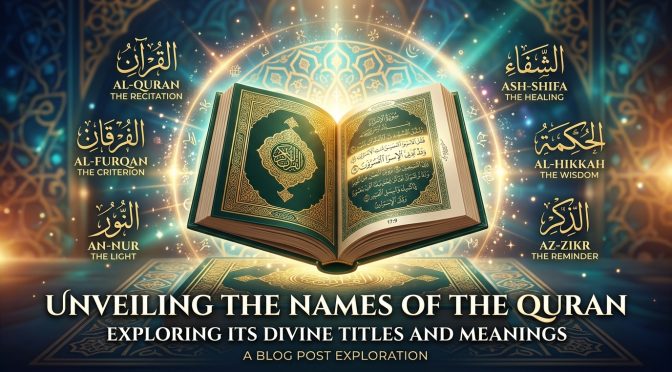
Unveiling the Names of the Quran: Exploring Its Divine Titles and Meanings

The Holy Quran stands as the central religious text of Islam, a divine revelation believed by Muslims to be the word of God (Allah) revealed to Prophet Muhammad (peace be upon him) over 23 years. More than just a book, it is considered a living miracle, a source of guidance, wisdom, and light for humanity until the end of time.

One of the profound aspects that highlights its multifaceted nature and divine origin is the sheer number of names attributed to it within its own verses. Each of these names of the Quran is not merely a label but a profound descriptor, unveiling a unique facet of its character, purpose, and unparalleled significance.

This comprehensive exploration delves into the myriad names of the Quran, unraveling their rich meanings and the profound insights they offer into the nature of this sacred scripture. By understanding these divine titles, believers can deepen their appreciation and connection to Allah’s ultimate message.

The Significance of Multiple Names for the Quran

It might seem unusual for a single book to possess so many distinct titles. However, for a text as profound and comprehensive as the Quran, these multiple names of the Quran are not redundant. Instead, they serve to emphasize its inexhaustible depths and the various ways it impacts human life and understanding. Just as a single diamond can reflect light in countless beautiful ways, the Quran, through its various names, reveals different aspects of its divine essence and function.

These names are not chosen arbitrarily; they are divinely ordained, each reflecting a specific attribute, quality, or role that the Quran plays. They highlight its power, clarity, guidance, healing, and truth, confirming its status as the ultimate word from the Creator to His creation. Exploring these various names of the Quran allows us to grasp its unparalleled majesty and the comprehensive scope of its divine message.

Prominent Names of the Quran and Their Profound Meanings

The Quran refers to itself by numerous names and epithets, each offering a unique lens through which to understand its divine character. Let’s explore some of the most prominent names of the Quran:

1. Al-Quran (The Recitation)

This is arguably the most common and widely recognized of all the names of the Quran. The word “Quran” itself is derived from the Arabic root “Qara’a,” meaning “to read” or “to recite.” It beautifully encapsulates the primary mode of its reception and dissemination – through oral recitation. For Muslims, the Quran is meant to be recited aloud, its melodic sounds and powerful verses resonating deeply, committing its words to memory and heart. This name emphasizes its living, audible nature, meant to be heard and pondered.

2. Al-Kitab (The Book)

Frequently appearing alongside “Al-Quran,” “Al-Kitab” signifies “The Book” or “The Scripture.” This name highlights its compiled, written form and its status as a complete, preserved scripture. While “Al-Quran” emphasizes its oral tradition, “Al-Kitab” stresses its comprehensive nature as a divinely revealed text, a testament to its preservation through both memorization and meticulous transcription. It is the definitive record of God’s final message, complete and unalterable, setting it apart from other books.

3. Al-Furqan (The Criterion / The Distinguisher)

From the Arabic root “faraqa,” meaning “to separate” or “to distinguish,” Al-Furqan means “The Criterion” or “The Distinguisher.” This powerful name of the Quran highlights its unique ability to differentiate between truth and falsehood, right and wrong, guidance and misguidance. It provides clear standards and principles by which to judge all matters of belief and conduct, serving as an ultimate benchmark for humanity. It empowers individuals to discern divine truth from human conjecture.

4. Al-Dhikr (The Remembrance / The Admonition)

Derived from “dhakara,” meaning “to remember” or “to mention,” Al-Dhikr translates to “The Remembrance,” “The Reminder,” or “The Admonition.” This name underscores the Quran’s role in reminding humanity of its covenant with God, its ultimate purpose, and its eventual return to Him. It serves as a constant admonition against heedlessness, urging people to reflect on God’s signs, remember His commands, and live a life conscious of His presence. It is a remembrance for those who have forgotten their spiritual origin.

5. Al-Tanzil (The Revelation / That Which Is Sent Down)

“Al-Tanzil” literally means “The Revelation” or “That which is sent down.” This name unequivocally asserts the divine origin of the Quran. It emphasizes that this book is not a product of human intellect or imagination but a direct descent of words from the Almighty Creator. It underscores the miraculous nature of its transmission from the heavens to the earth, through the Angel Gabriel, to the heart of Prophet Muhammad (PBUH), establishing its unquestionable authority and sacredness.

6. Al-Nur (The Light)

Meaning “The Light,” Al-Nur beautifully describes the Quran’s function as a beacon that illuminates the path for humanity. In a world often darkened by ignorance, doubt, and moral confusion, the Quran shines as a guiding light, dispelling darkness and leading people towards righteousness, knowledge, and truth. It enlightens hearts and minds, providing clarity on complex issues and illuminating the path to salvation and spiritual well-being.

7. Al-Huda (The Guidance)

As “The Guidance,” Al-Huda encapsulates the Quran’s primary purpose. It provides a comprehensive roadmap for all aspects of life – spiritual, moral, social, and legal. It guides individuals towards piety, justice, and success in both this world and the hereafter. This name emphasizes its practical utility, offering clear directions and principles for navigating the complexities of human existence and achieving ultimate fulfillment.

8. Al-Shifa (The Healing)

“Al-Shifa” translates to “The Healing” or “The Cure.” This name highlights the Quran’s profound ability to heal spiritual ailments, doubts, and moral diseases that afflict the human heart and soul. It offers solace, peace, and spiritual remedies for anxiety, despair, and confusion. Beyond spiritual healing, many believers also find comfort and healing from physical ailments through its recitation, recognizing its blessed nature.

9. Al-Hikmah (The Wisdom)

When the Quran is referred to as “Al-Hikmah,” “The Wisdom,” it points to the profound, deep, and perfect knowledge contained within its verses. It is not merely information but divine wisdom, distinguishing between truth and falsehood, providing optimal solutions to human problems, and revealing the underlying purposes of creation and existence. Its teachings are founded on ultimate truth and perfect understanding.

10. Al-Maw’izah (The Admonition / The Exhortation)

“Al-Maw’izah” means “The Admonition” or “The Exhortation.” This name highlights the Quran’s role in providing earnest counsel, warnings, and moral lessons to humanity. It gently yet firmly reminds people of their duties, the consequences of their actions, and encourages them towards piety and good deeds. It is a continuous source of moral instruction and spiritual awakening.

11. Al-Burhan (The Proof / The Evidence)

Meaning “The Proof” or “The Evidence,” Al-Burhan signifies that the Quran itself is an undeniable argument for the truth of Islam and the oneness of God. Its miraculous linguistic structure, profound prophecies, scientific allusions (understood in context), and consistent message serve as irrefutable evidence of its divine origin. It stands as a clear and conclusive proof for those who seek truth with an open heart.

12. Al-Haqq (The Truth)

“Al-Haqq” literally means “The Truth.” This name asserts that the Quran is the absolute and ultimate truth from God. It contains nothing but truth, free from error, contradiction, or falsehood. It reveals the true nature of God, the universe, and humanity’s purpose, distinguishing itself from all other narratives and philosophies which may contain elements of conjecture or human error. It is the word of the ultimately True One.

13. Al-Mubin (The Clear / The Manifest)

Translated as “The Clear” or “The Manifest,” Al-Mubin signifies that the Quran’s message is unambiguous, easy to understand for those who reflect, and clearly distinguishes between right and wrong. It removes doubts and makes the path of guidance evident. Its clarity is a mercy, allowing humanity to grasp its fundamental principles and apply them in their lives without confusion.

14. Al-Aziz (The Mighty / The Noble)

When referred to as “Al-Aziz,” meaning “The Mighty” or “The Noble,” the Quran’s inviolability and power are emphasized. It is a book that cannot be corrupted, altered, or defeated. Its message is powerful, its authority unquestionable, and its protection divinely guaranteed. This name underscores its exalted status and the invincibility of its truth.

15. Al-Karim (The Noble / The Generous)

“Al-Karim,” “The Noble” or “The Generous,” highlights the esteemed status of the Quran and the bounties it bestows upon those who engage with it. It is a noble revelation, full of blessings, wisdom, and rewards for its readers and practitioners. It generously offers guidance, peace, and salvation to humanity.

Deeper Insights into the Names of the Quran

The existence of so many profound names of the Quran is not a mere literary flourish; it is a testament to the comprehensive and perfect nature of Allah’s final revelation. Each name adds a layer of understanding, encouraging believers to interact with the Quran on multiple levels.

By reflecting on “Al-Furqan,” we are reminded of its crucial role in helping us navigate moral dilemmas. “Al-Nur” inspires us to seek its wisdom in times of confusion. “Al-Shifa” invites us to find solace and healing in its verses. Collectively, these names of the Quran paint a holistic picture of a divine scripture that is a guide, a reminder, a light, a healer, a proof, and an undeniable truth – all in one.

Understanding these names also deepens our appreciation for the linguistic brilliance of the Arabic language, through which the Quran was revealed. The precision and richness of Arabic allow for such nuanced and multifaceted descriptions, each word carrying profound significance. It reinforces the belief that the Quran is indeed a miraculous text, perfectly preserved and perfectly described by its Creator.

Conclusion

The journey through the various names of the Quran is a profound exploration into the heart of Islamic faith. Each title, whether it is Al-Quran, Al-Kitab, Al-Furqan, or Al-Nur, unlocks a deeper dimension of this divine scripture, revealing its multifaceted nature and its unparalleled importance for humanity. These names are not just labels; they are epithets that describe its origin, its purpose, its power, and its transformative potential.

By acknowledging and reflecting upon these diverse names of the Quran, believers can foster a richer, more profound relationship with Allah’s final message. They serve as a constant reminder that the Quran is far more than just a historical text; it is a living, breathing guide, a source of light, healing, and wisdom that continues to illuminate the lives of millions across the globe, leading them towards truth, justice, and eternal success. May our engagement with the Quran always be one of deep respect, reflection, and sincere application of its timeless teachings.

Frequently Asked Questions (FAQ)

Q1: Why does the Quran have so many names?

The Quran has numerous names to highlight its multifaceted nature, comprehensive scope, and diverse functions. Each name describes a unique attribute or role of the divine scripture, such as its ability to guide, heal, distinguish truth from falsehood, or serve as a light. These multiple names of the Quran emphasize its profound significance and perfect design.

Q2: Are all these names mentioned within the Quran itself?

Yes, many of the prominent names of the Quran, such as Al-Quran, Al-Kitab, Al-Furqan, Al-Dhikr, Al-Nur, and Al-Huda, are explicitly mentioned within its own verses. These self-referential titles further underscore their divine origin and authority, making them an integral part of the scripture’s identity.

Q3: What is the most common name for the Quran?

The most common and widely recognized name for the holy book is “Al-Quran” itself, meaning “The Recitation.” This name emphasizes its oral tradition and the importance of its recitation in Islamic practice.

Q4: Do these different names imply different versions or parts of the Quran?

No, the multiple names of the Quran do not imply different versions or parts. They all refer to the single, unified, and divinely preserved text that Muslims believe to be the complete and final revelation from Allah. The different names merely highlight various aspects and characteristics of this one sacred book.

Q5: How does understanding these names enhance a Muslim’s relationship with the Quran?

Understanding the various names of the Quran deepens a Muslim’s appreciation for its comprehensive guidance and divine wisdom. It allows for a more nuanced and holistic engagement with the text, recognizing its role as a light, a healer, a criterion, and an admonition. This deeper understanding can inspire greater reverence, reflection, and commitment to living by its teachings.
What is Salah? Understanding its Meaning and Immense Importance in Islam

Introduction to Salah in Islam

Salah (also spelled as “Salat” and “Namaz”) is the second pillar of Islam and refers to the obligatory prayers that Muslims perform five times a day. It is a form of worship that connects a Muslim with Allah (God) through devotion, humility, and gratitude.

Salah or Namaz is not just a routine but a profound act of submission and obedience, serving as a reminder of the Creator’s presence in a believer’s life.

Each of the five prayers—Fajr, Dhuhr, Asr, Maghrib, and Isha—is performed at specific times throughout the day, offering Muslims a structured way to remain in constant touch with their faith and purpose.

The five daily prayers are:

  1. Fajr – Performed at dawn.
  2. Dhuhr – Performed in the early afternoon.
  3. Asr – Performed in the late afternoon.
  4. Maghrib – Performed just after sunset.
  5. Isha – Performed at night.

Importance of salah in Islam

Importance of Salah in Islam

1. Salah: A Lifeline to Spiritual Connection with Allah and a Reminder of His Presence

Salah is a means through which Muslims connect with Allah daily. It provides an opportunity for believers to pause from their worldly affairs and dedicate moments of their day to reflect on their relationship with their Creator.

The act of prayer helps Muslims acknowledge Allah’s greatness and mercy while humbling them before Him. This connection is more than just a ritual; it is a direct conversation with Allah, asking for guidance, mercy, and forgiveness. It creates a deep sense of peace and tranquility, reminding Muslims of their dependence on Allah in every aspect of life.

 2. The Central Role of Salah as One of the Five Pillars of Islam

As one of the five pillars of Islam, Salah is foundational to a Muslim’s faith and practice. Its significance cannot be overstated, as it represents complete submission to Allah’s commands. The Prophet Muhammad (PBUH) emphasized that neglecting Salah weakens one’s commitment to Islam, and regular prayer is considered a distinguishing feature of a true believer.

By observing Salah regularly, Muslims reinforce their dedication to fulfilling one of Islam’s core obligations, nurturing a relationship with Allah that strengthens their faith.

3. Salah as a Means of Spiritual and Moral Purification: Cleansing the Soul and Guarding Against Sin

Salah not only cleanses the soul but also helps purify the mind and actions of a believer. The physical, verbal, and mental aspects of prayer work together to purify a Muslim from sins, wrongdoings, and immoral thoughts.

According to the Qur’an (Surah Al-Ankabut, 29:45), Salah plays a crucial role in preventing indecency and immoral behavior. When performed with sincerity and mindfulness, Salah acts as a shield against negative influences, leading Muslims toward a righteous path of living under Allah’s guidance.

4. Fostering Unity and Equality Among Believers: The Congregational Aspect of Salah

Salah, particularly when performed in a congregation at a mosque, fosters a powerful sense of unity and equality among Muslims. Regardless of race, nationality, or social status, all worshippers stand shoulder to shoulder, forming rows and praying together as equals before Allah.

This demonstrates that in Islam, all individuals are seen as equal in the eyes of the Creator, without distinction of wealth, background, or social rank. The act of praying together strengthens the bonds of brotherhood and sisterhood, promoting community spirit and solidarity among Muslims.

5. How Salah Builds Discipline and Structure in a Muslim’s Daily Life

The five daily prayers are scheduled at specific times throughout the day, which helps Muslims establish a disciplined routine that revolves around their faith. By performing Salah at regular intervals—dawn, noon, afternoon, sunset, and night—Muslims are encouraged to be mindful of their time and responsibilities.

This structure fosters a sense of purpose, ensuring that a Muslim’s day is centered around their relationship with Allah. The discipline cultivated through Salah reflects in other areas of life, promoting time management, self-control, and a greater awareness of one’s actions and responsibilities.

 Conclusion

Salah is far more than just a religious duty in Islam; it is a profound act of worship that nourishes a Muslim’s soul, connects them with Allah, and brings peace to their heart. By performing Salah regularly, Muslims experience personal transformation, finding guidance, strength, and clarity in their lives. The discipline, unity, and spiritual benefits derived from Salah make it an essential practice for every Muslim, helping them grow closer to Allah and live a life of purpose and righteousness.

The Role of Prophet Muhammad (PBUH) in Islam: Messenger, Leader, and Guide

Prophet Muhammad (PBUH) holds a central and revered position in Islam, serving as the final messenger of Allah and the ultimate model of human conduct. His role as a prophet extends beyond merely delivering divine revelations; he was also a transformative leader and an enduring guide for all aspects of life.

Through his life, teachings, and exemplary character, Prophet Muhammad (PBUH) shaped the course of Islamic civilization and left a lasting legacy that continues to inspire Muslims around the world.

1. The Final Messenger of Allah

As the final messenger in a long line of prophets, Prophet Muhammad (PBUH) was tasked with conveying the last and complete message of Allah to humanity. Known as the “Seal of the Prophets” (Khatam an-Nabiyyin), he came to confirm the revelations sent to earlier prophets like Adam, Noah, Abraham, Moses, and Jesus (peace be upon them). His mission was to deliver the message of monotheism, calling people to worship the One True God (Allah) and guiding them to live righteous lives by divine will.

The Qur’an, revealed to Prophet Muhammad (PBUH) over 23 years, is the ultimate source of guidance for Muslims. It addresses every aspect of life, from spiritual matters to social, legal, and moral issues. The Qur’an is considered the literal word of Allah, and the Prophet (PBUH) was its faithful transmitter. His duty was to teach, explain, and implement the Qur’an in real-life situations, serving as both the mouthpiece of divine revelation and the living example of its teachings.

Allah says in the Qur’an:

“Muhammad is not the father of [any] one of your men, but [he is] the Messenger of Allah and the seal of the prophets. And ever is Allah, of all things, Knowing.” (Surah Al-Ahzab 33:40).

This verse confirms the finality of his Prophethood and his unique status as the last messenger entrusted with guiding humanity.

2. A Leader and Statesman

Prophet Muhammad (PBUH) was not only a spiritual guide but also a visionary leader and statesman who established the foundations of an Islamic society. After migrating to Medina, he took on the role of both spiritual and political leader, uniting the diverse tribes and communities under a single framework of justice, governance, and mutual respect.

One of his most significant achievements as a leader was the Constitution of Medina, which outlined the rights and responsibilities of Muslims, Jews, and other groups living in Medina. This constitution created a pluralistic society, fostering peaceful coexistence and cooperation among different religious and tribal groups.

It was an early example of a social contract that established the principles of justice, equality, and the rule of law.

As a leader, the Prophet (PBUH) was known for his wisdom, humility, and fairness. He led by example, always showing concern for the well-being of others and prioritizing justice, even in the face of personal hardship.

His leadership style was not authoritarian but based on consultation (shura), compassion, and trust in Allah. He was a servant-leader who believed in serving his community and working for the greater good.

The Prophet’s leadership qualities were evident in his ability to inspire loyalty and devotion among his followers. He transformed a fragmented society into a unified and powerful Ummah (Muslim community), which later became a global civilization.

3. A Guide for All of Humanity

Prophet Muhammad (PBUH) is regarded by Muslims as the best example of how to live in accordance with the will of Allah. His Sunnah, which comprises his actions, sayings, and practices, is a practical guide for Muslims in all aspects of life.

The Qur’an describes the Prophet (PBUH) as a “mercy to the worlds” (Surah Al-Anbiya 21:107), signifying his universal role as a guide for all of humanity.

His teachings encompass every domain of life—spiritual, moral, social, political, and personal. The Prophet (PBUH) taught his followers how to pray, fast, give charity, and perform pilgrimage, but he also guided them in their interpersonal relationships, emphasizing kindness, forgiveness, and generosity.

His example provides a model of ethical behavior and virtuous living, which Muslims strive to emulate. A key aspect of his guidance was his emphasis on moral character.

The Prophet (PBUH) said:

“I was sent to perfect good character.” (Musnad Ahmad).

His life embodied qualities such as honesty, humility, patience, and compassion, which are central to Islamic teachings. He was known for his gentleness with children, respect for women, care for the poor, and fairness in all matters. His actions reflect the high moral standards he sought to instill in his followers.

The Prophet’s (PBUH) guidance also extended to matters of justice and human rights. He advocated for the rights of women, children, and slaves, challenging the social norms of his time. He emphasized the importance of education, cleanliness, and personal discipline.

His teachings remain relevant today as a source of wisdom and guidance in both personal and societal matters.

4. An Advocate for Peace and Reconciliation

As a messenger of peace, Prophet Muhammad (PBUH) sought to reconcile conflicting groups and promote harmony among diverse communities. His message of Islam, which means “submission” and is derived from the word for peace, was aimed at bringing inner and outer peace to individuals and societies.

Throughout his life, the Prophet (PBUH) resolved conflicts through peaceful negotiation, diplomacy, and compassion.

For instance, the Treaty of Hudaybiyyah is a notable example of the Prophet’s commitment to peace. Despite the initial reluctance of his followers, the Prophet (PBUH) agreed to a peace treaty with the Quraysh tribe, which temporarily prevented Muslims from performing the pilgrimage to Mecca.

This treaty not only averted bloodshed but also opened the door for peaceful relations and, eventually, the peaceful conquest of Mecca.

The Prophet’s emphasis on peace is further exemplified by his stance on forgiveness. When he returned to Mecca after years of persecution by the Quraysh, he forgave his enemies, declaring:

“There shall be no reproof against you this day. Allah will forgive you; and He is the most merciful of the merciful.” (Surah Yusuf 12:92).

This act of forgiveness not only exemplified his magnanimity but also set a powerful example of how reconciliation can lead to lasting peace.

5. A Role Model for Social Justice

The Prophet Muhammad (PBUH) was deeply committed to social justice, advocating for the rights and dignity of all individuals, regardless of their status. He condemned tribalism, racism, and social inequalities, teaching that all people are equal in the eyes of Allah.

His Farewell Sermon delivered during his final pilgrimage to Mecca, emphasized this message:

“All mankind is from Adam and Eve. An Arab has no superiority over a non-Arab, nor does a non-Arab have any superiority over an Arab; a white has no superiority over a black, nor does a black have any superiority over a white; none have superiority over another except by piety and good action.”

This sermon laid the foundation for a society based on equality, fairness, and justice. The Prophet (PBUH) encouraged his followers to care for the weak, support the poor, and treat everyone with respect. He emphasized that a person’s worth is determined by their faith and conduct, not by their lineage or wealth.

6. A Source of Mercy and Compassion

Prophet Muhammad (PBUH) was described in the Qur’an as a mercy to the world (Surah Al-Anbiya 21:107). His life was marked by compassion, not only for humans but also for animals and the environment.

He was known for his kindness toward those who were vulnerable, including orphans, widows, and the poor. He taught his followers to show mercy in all situations, whether in dealing with family, friends, strangers, or even enemies.

His sense of mercy extended to all creatures. The Prophet (PBUH) advised kindness to animals and discouraged unnecessary harm to them. He once said:

“Whoever is kind to the creatures of God is kind to himself.” (Bukhari).

This profound mercy is a reflection of the Islamic principle that all of creation is interconnected, and caring for others is a means of attaining Allah’s pleasure.

Conclusion

Prophet Muhammad (PBUH) played a multifaceted role in Islam as the final messenger, a visionary leader, and an exemplary guide. His mission was not only to deliver the message of Islam but to lead by example, embodying the values of justice, compassion, and mercy.

Prophet Muhammad (PBUH) established a just society that promoted peace, equality, and the dignity of all individuals. His Sunnah remains a timeless source of guidance for Muslims, offering practical lessons on how to live a life that is pleasing to Allah and beneficial to humanity.

The Spiritual Benefits of Surah Yasin in the Lives of Muslims

Surah Yasin is one of the most important chapters of the Quran. It is often called the “heart of the Quran” by Muslims. This chapter has 83 verses and is found in the 36th chapter of the Quran.

Hadith on Reciting Surah Yaseen

There are several Hadiths (sayings of the Prophet Muhammad, PBUH) that highlight the virtues of reciting Surah Yasin.

Here are a few well-known ones

Recite Surah Yasin, for it will come as an intercessor for its reciter on the Day of Judgment. (Reported by Abu Dawood, Ibn Majah, and Al-Bayhaqi)

This hadith emphasizes that Surah Yasin will advocate for the person who recites it regularly and sincerely.

Whoever recites Surah Yasin at night, seeking the pleasure of Allah, will be forgiven. (Reported by At-Tabarani)

This narration suggests that reading Surah Yasin with pure intention before sleeping can lead to Allah’s forgiveness.

Recite Yasin on those who are dying. (Reported by Abu Dawood and Ibn Majah)

This hadith indicates that Surah Yasin is recited for those nearing death, bringing peace and easing the soul’s journey.

Everything has a heart, and the heart of the Quran is Yasin. Whoever recites Yasin, Allah will record for him the reward of reciting the Quran ten times. (Reported by At-Tirmidhi)

In this narration, Surah Yasin is described as the “heart of the Quran,” signifying its spiritual benefits and the immense rewards for reciting it.

These Hadiths reflect the deep spiritual value of Surah Yasin in Islamic practice.

The Unique Spiritual and Religious Benefits of Surah Yaseen in Islam

Surah Yaseen has deep spiritual benefits. Many Muslims recite it for blessings, forgiveness, and protection. The Prophet Muhammad (PBUH) said that reciting Surah Yasin brings many rewards.

How Yasin Brings Peace, Comfort, and Emotional Strength to Believers

When someone is in distress, reciting Surah Yasin can bring peace. Many Muslims read this surah when they are feeling anxious or sad. Its words remind believers that Allah is in control of everything. It strengthens faith and helps them stay patient in difficult times.

The Role of Yasin in Seeking Forgiveness and Attaining Allah’s Mercy

Surah Yasin is also known for its connection to seeking forgiveness. It is believed that whoever reads it with a sincere heart will receive Allah’s mercy. Many people read this surah to ask for forgiveness for themselves and others.

Reciting Yasin for Protection from Harm and Negative Influences

Some Muslims recite Surah Yasin for protection. It is said to keep away harm and evil. By reading this surah, believers feel safe and secure. It is often read in the morning or evening for protection during the day or night.

Surah Yasin as a Source of Ease and Relief in Difficult Life Situations

People often recite Surah Yasin when they face challenges. It helps bring ease in tough times. Many believe that it opens doors to new opportunities and makes problems easier to handle.

The Significance of Reciting Yasin for the Deceased & Its Spiritual Benefits

Surah Yasin is often recited when someone passes away. Muslims believe that reciting it helps the soul of the deceased. It brings comfort to their loved ones and asks for Allah’s mercy on the departed.

Conclusion

Surah Yasin holds a special place in the hearts of Muslims. Its powerful words bring peace, forgiveness, and protection. Reciting it regularly is a way to strengthen one’s faith and seek Allah’s blessings. Whether in times of joy or hardship, Surah Yasin is a source of spiritual strength for believers.